
ArbitralWomen and Hogan Lovells Host Panel Discussion in Milan
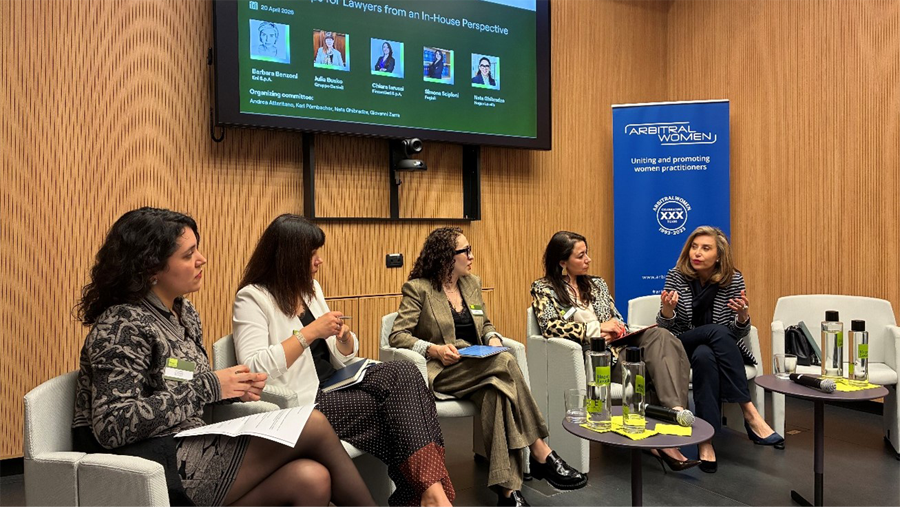
On 20 April 2026, ArbitralWomen was delighted to co-host, together with Hogan Lovells’ Italian and German International Arbitration teams, a panel discussion on “Arbitration: Practical Tips from an In-House Perspective,” held at Hogan Lovells’ Milan office. The event brought together arbitration practitioners, in-house counsel and dispute resolution specialists for an open and practical conversation on how international arbitration is managed from within companies, where legal considerations must be continuously balanced with commercial priorities, operational constraints and strategic objectives.
The event was conceived as an opportunity to move beyond traditional discussions of arbitration framed around procedural efficiency, best practices or doctrinal analysis. Instead, the focus was placed on the internal dynamics of decision making within companies and on the real expectations that in house legal teams have when working with external counsel. Against this backdrop, the discussion explored how disputes are assessed, prioritised and managed in practice, and what truly adds value from an in house perspective at different stages of a dispute’s lifecycle.
The panel was moderated by ArbitralWomen Board Secretary Nata Ghibradze, who opened the discussion by highlighting a core message that resonated throughout the event: disputes are not merely legal exercises, but business decisions that carry financial, reputational and operational consequences. The moderator set the tone for a candid and commercially grounded exchange, encouraging panellists to reflect honestly on the gaps that can arise between external legal advice and internal business realities. She was joined by an outstanding group of in house counsel, each bringing a distinct industry perspective: Barbara Benzoni, Head of Legal for International Mid Downstream and Chemicals at Eni; Julia Busko, Senior Legal Counsel at Gruppo Danieli; Chiara Larussi, Head of Corporate and Special Contracts at Fincantieri; and Simona Scipioni, Legal Counsel at Fagioli.
The discussion was structured around a series of targeted questions designed to explore, first, the areas of disconnect most commonly experienced by in house teams when engaging external counsel. Panellists described how arbitration advice often needs to circulate internally among non lawyers, including engineers, commercial managers and senior management, and how overly legalistic or exhaustive analyses can lose effectiveness when translated into business decisions. Several speakers noted that the challenge is rarely the quality of the legal work itself, but rather the lack of calibration to internal processes, decision making timelines and commercial sensitivities. In this context, panellists highlighted the tension between arbitration timelines and business imperatives, particularly in industrial environments where projects must continue despite disputes. They emphasised that in house counsel often operate under significant pressure to keep operations moving while managing legal risk, and that external advisers who fail to appreciate this reality risk providing advice that is technically sound yet practically unworkable.
The conversation then shifted to what actually works from an in-house perspective. A recurring theme was the importance of external counsel demonstrating a deep understanding of the client’s industry and operating environment. Panellists stressed that advisers who invest time in understanding the technical, commercial and geopolitical context of a dispute are better positioned to provide advice that is both relevant and actionable. Practical, solution-oriented advice, presented clearly and concisely, was consistently identified as more valuable than theoretical completeness. Trust also emerged as a central element in successful relationships between in-house teams and external counsel. The speakers emphasised that trust is built over time through availability, responsiveness and consistency, as well as through the ability to anticipate issues and proactively flag risks. External counsel who understand how to communicate legal risk effectively to different internal stakeholders – tailoring their message from project teams to the boardroom – were seen as particularly effective partners.
The panel concluded with a rapid-fire round, distilling the discussion into practical takeaways for external practitioners. Among the key messages were the need to:
• avoid over-lawyering,
• proactively understand and anticipate client needs,
• remain pragmatic under pressure, and
• align legal strategy closely with commercial objectives.
The speakers agreed that true differentiation lies not in asserting excellence, but in demonstrating an understanding of the client’s world before being asked.
ArbitralWomen warmly thanks the moderator, the panellists, all participants, and Hogan Lovells for their generous hosting and collaboration in making this event a thoughtful, practical and engaging contribution to the ongoing dialogue between in house counsel and arbitration practitioners.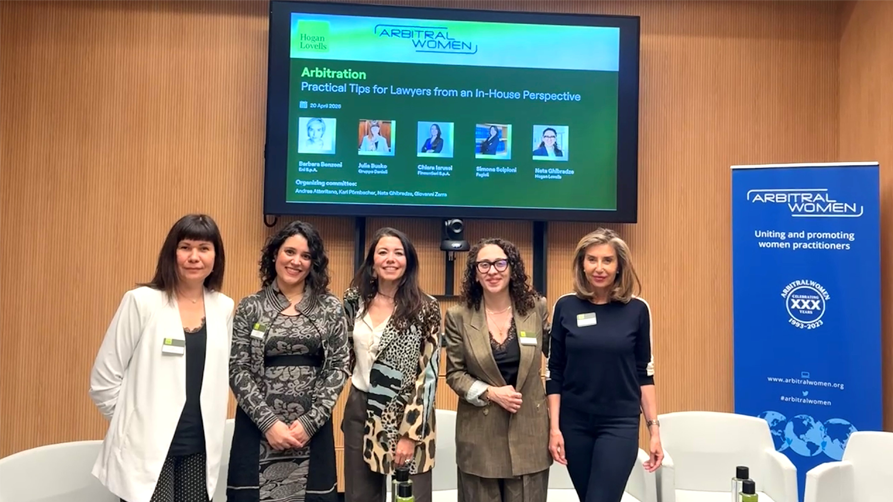
Submitted by ArbitralWomen Member Maria Giulia Tammaro (Foreign Associate, Hogan Lovells)